Intergenerational Mobility in the Land of Inequality

What is this research about, and why did you do it?
Brazil is one of the world's most unequal countries, yet little is known about how much of this extreme inequality persists across generations. This paper provides the first estimates of intergenerational income mobility (IGM) for a large developing country using tax data. A central challenge is that nearly a third of Brazil's economy is informal — unrecorded in administrative registries. We develop a method to measure both formal and informal income, enabling the study of mobility for a representative sample of 1.3 million children born between 1988 and 1990 and their parents.
How did you answer this question?
We combine individual-level data from Brazilian administrative registries — including income tax filings and payroll records — with large household surveys. Using machine learning models trained on survey data, we predict informal income for individuals not fully captured in administrative sources, achieving comprehensive income measurement for both parents and children. We estimate rank-rank regressions, transition matrices, and absolute mobility measures nationally, by gender and race, and across fine geographical areas. We also estimate causal place effects using within-sibling variation in age at move among children of migrating families.
What did you find?
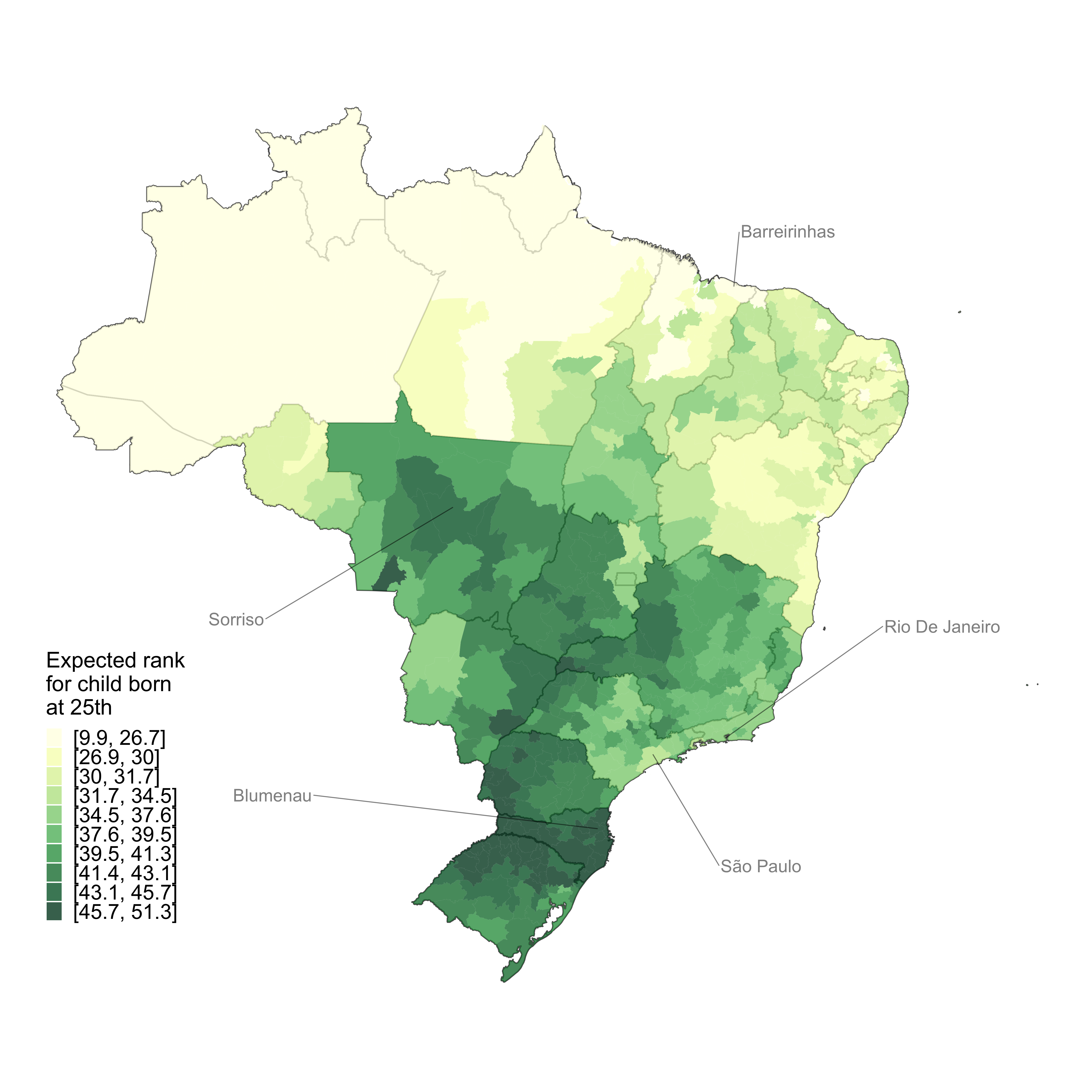
Income mobility in Brazil is very low by international standards. A 10-percentile increase in parental income rank is associated with a 5.5-percentile increase in child income rank (rank-rank slope = 0.55), well above comparable estimates for the US (0.34) and European countries (0.19–0.30). Children born to below-median income parents reach only the 36th percentile on average, with substantial regional variation. Non-white children rank 7 percentiles below white children with the same parental income, and girls rank 14 percentiles below boys — gaps largely driven by labour market disparities. Causal place effects explain over half of the observed regional variation in mobility.
What implications does this have for the study (research and teaching) of wealth concentration or economic inequality?
Our findings show that Brazil's extreme income inequality is highly persistent across generations, consistent with the Great Gatsby curve. The paper offers a methodological template — combining administrative records, household surveys, and machine learning — for estimating IGM in developing countries where informality limits reliance on tax data alone. This framework can be applied across the Global South, expanding the frontier of mobility research beyond high-income countries and informing debates about the role of place, race, and gender in perpetuating inequality.
What are the next steps in your agenda?
We are currently studying the intergenerational effects of Brazil’s Bolsa Família program (PBF), one of the world’s largest conditional cash transfers. Using a sibling difference-in-differences design and population-wide administrative data, we examine whether PBF durably breaks the cycle of poverty and raises upward mobility in the next generation.
Citation and related resources
Britto, D. G. C., Fonseca, A., Pinotti, P., Sampaio, B., and Warwar, L. (2026). “Intergenerational Mobility in the Land of Inequality.” Review of Economics and Statistics, forthcoming.