


Racial Inequality and Redistribution in Post-Apartheid South Africa

What is this research about and why did you do it?
South Africa’s first universal democratic election took place in 1994 and marked the end of centuries of racist institutions. Major reforms were then carried out by successive governments, with the objective of reducing the extreme levels of inequality inherited from Apartheid. To understand to what extent South Africa’s post-Apartheid transformations have met the expectations of the early 1990s, we study the evolution of overall and racial inequalities, before and after tax and transfers, from 1993 to 2019.
How did you answer this question?
Using the Distributional National Accounts framework, we produce factor income series by harmonising household surveys, correcting top income with tax tabulations and rescaling to national aggregates. We then obtain pretax income series by accounting for the incidence of the pension system, unemployment insurance and informal private transfers. Last, we move to posttax income by allocating each tax and each government transfers and services in a particularly detailed way. The resulting microdatabase covers the joint distribution of income, expenditure, wealth, taxes, and transfers in a way consistent with macroeconomic growth, administrative budget data, and racial population statistics from 1993 to 2019.
What did you find?
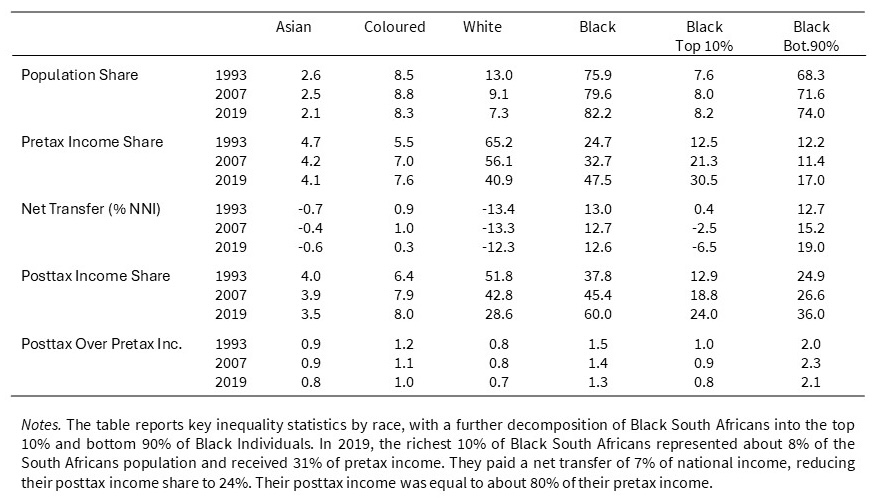
Two distinct periods emerge. Between 1993 and the mid-2000s, pretax inequality rose, racial disparities widened, and redistribution stagnated. From the mid-2000s onward, pretax inequality declined while posttax inequality fell more rapidly as social spending and personal income taxation expanded. By 2019 the White-to-Black income ratio had halved since 1993—yet nearly half of this decline stemmed from the exceptional income growth of the top 10% of Black earners. Despite major redistribution, South Africa remains the world's most unequal country in the world for which comparable data exist and the racial income gap remains extreme by international standards.
What implications does this have for the study (research and teaching) of wealth concentration or economic inequality?
This paper provides the first comprehensive long-run assessment of how growth, taxes and transfers contribute to shape overall and racial inequality in an emerging economy, setting a benchmark for future comparative work. Our findings demonstrate how persistent inherited economic structures may be despite major institutional changes. They also illustrate how the transition to a democratic regime can have very heterogenous consequences for the previously dominated group.
What are the next steps in your agenda?
Future research should investigate the mechanisms behind the exceptional income growth of top Black earners—whether driven by the dismantling of discriminatory laws or by the adoption of pre-redistribution public policies favouring previously oppressed racial groups.
Citation and related resources
Czajka, L. and Gethin, A. (2025). "Racial Inequality and Redistribution in Post-Apartheid South Africa." EUTAX Working Paper, December 2025.

%20Amory%20Gethin.png)