Rural Migrants and Urban Informality: Evidence from Brazil

What is this research about and why did you do it?
The urban population in developing countries grew by 12.5 percent between 2015 and 2020, and it is projected to grow by 64.7 percent by 2050 (UNCTAD, 2021). Part of this growth is driven by rural-urban migration, which is expected to intensify due to climate change. Whether urban developing economies will be able to generate enough good jobs to accommodate this fast-growing workforce is a fundamental question for economic development. The consensus among economists since Harris and Todaro (1970) and Fields (1975) is that rural-urban migrants end up unemployed or informally employed. The empirical evidence that confirms this view is mostly based on short-term (year-on-year) effects of rural-urban migration. This begs the question of what happens over longer time horizons?
How did you answer this question?
In our paper (Imbert and Ulyssea 2026), we challenge this pessimistic consensus by examining the decade-long effects of drought-induced migration on Brazilian cities between 2000 and 2010. We track nearly 3,600 municipalities over the decade, combining census data on workers with administrative records covering the universe of formal firms and employees. To identify the causal effects of migration, we use a shift-share IV design that combines droughts during the growing season in origin regions with historical migration patterns to isolate exogenous variation in the inflow of migrants. To dig deeper into mechanisms, we also develop a new model of firm dynamics and informality.
What did you find?
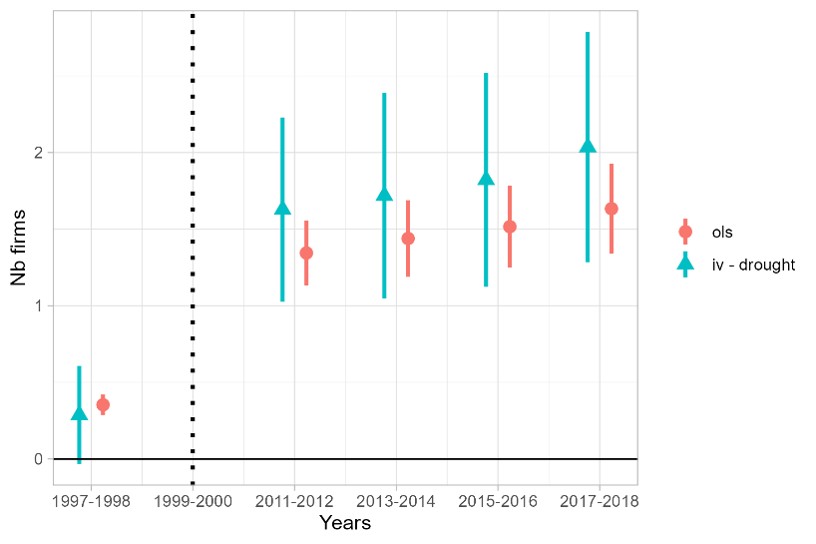
We find that a one percentage point increase in a city's immigration rate increases formal employment by 0.27 percentage points (a 1.2% increase). This effect is entirely driven by a movement of workers from informal to formal jobs, with no change in wage employment overall, unemployment, or self-employment. Wages in the formal sector fall by 0.6 percent while informal wages are unaffected. On the firm side, we find that an increase in the immigration rate by one percentage point leads to a 1.6% increase in the number of firms and a 2% increase in the number of formal jobs.
Why are the results so different from previous work?
We propose two complementary explanations. First, the time horizon. When we adopt the short-run, year-to-year specification typically used in the literature we replicate earlier findings: migration increases informal employment in the immediate aftermath. The formalization effects we document emerge only over longer time horizons. Second, downward nominal wage rigidity (DNWR) in the formal sector. We show empirically that in municipalities with high DNWR the formalization effects of immigration are smaller or even completely muted, and non-employment increases. Importantly, DNWR matters more in the short than the long run, as inflation and worker turnover allow real wages to adjust downward over time. These findings also echo the “Harris-Todaro-Fields” view that when formal wages are rigid rural-urban migration leads to higher urban unemployment and informality.
What are the policy implications?
Our findings carry important messages for policymakers managing rapid urbanization and climate-driven migration. First, the immediate labor market disruption from migration—which previous research has documented—represents a transitional phase. Second, labor market flexibility is crucial. This poses a difficult trade-off: wage floors protect existing workers but may prevent the formal sector from absorbing new arrivals, pushing them into informality or unemployment instead. Third, the informal sector plays a complex role. While it constitutes an employment buffer during adjustment periods it also shelters low-productivity firms, thus dampening the long run dividends of immigration. Finally, our research suggests that urban developing economies may experience demographic dividends from climate migration, even as climate change poses severe challenges. The key is to create labor market conditions that allow cities to translate population growth into formal job creation rather than increased informality.
What are the next steps in your agenda?
We are investigating climate migration in Brazil in two complementary projects. The first, joint with Diogo Britto, Alexandre Fonseca and Breno Sampaio, evaluates the provision of cisterns, or water tanks, to rural households from the semi-arid regions (“1 million cisterns program”). We leverage large administrative data to estimate its effect on migration and mortality. The second, joint with Viktor Veterinarov, uses census data to study the creation of migrant networks in response to droughts over the long run and its effects on later waves of climate migration.