


Shaping inequality and intergenerational persistence of poverty: Free college or better schools?

What is this research about and why did you do it?
Should governments make college free, or spend more on public schools? Recent policy proposals put these questions centre stage, from tuition-free community college in several states to record public-school funding expansions in Pennsylvania and New York. Intergenerational educational inequality is enormous: 13% of children of single parents without high-school degrees attend college; 92% of college graduates’ children do. If disadvantaged children reach age 18 under-prepared for college, subsidising tuition may be the wrong instrument, and investing in better public schools might have higher social payoffs. We run a horse race between the policies and their combinations, at equal fiscal cost.
How did you answer this question?
We build a quantitative general equilibrium model of the US economy where children’s skills are formed in childhood by parental time, money and public school spending, and early skills raise returns to later investments. Skills determine whether teenagers finish high school, enter college and graduate. Parents—married couples and single mothers—choose investments in child human capital and later inter-vivos transfers; wages, taxes and government debt adjust endogenously. Having validated the model against recent micro evidence on school-funding and tuition policies, we compare two debt-financed reforms of equal fiscal cost—free college and better-funded schools—and compute their welfare-maximising combination.
What did you find?
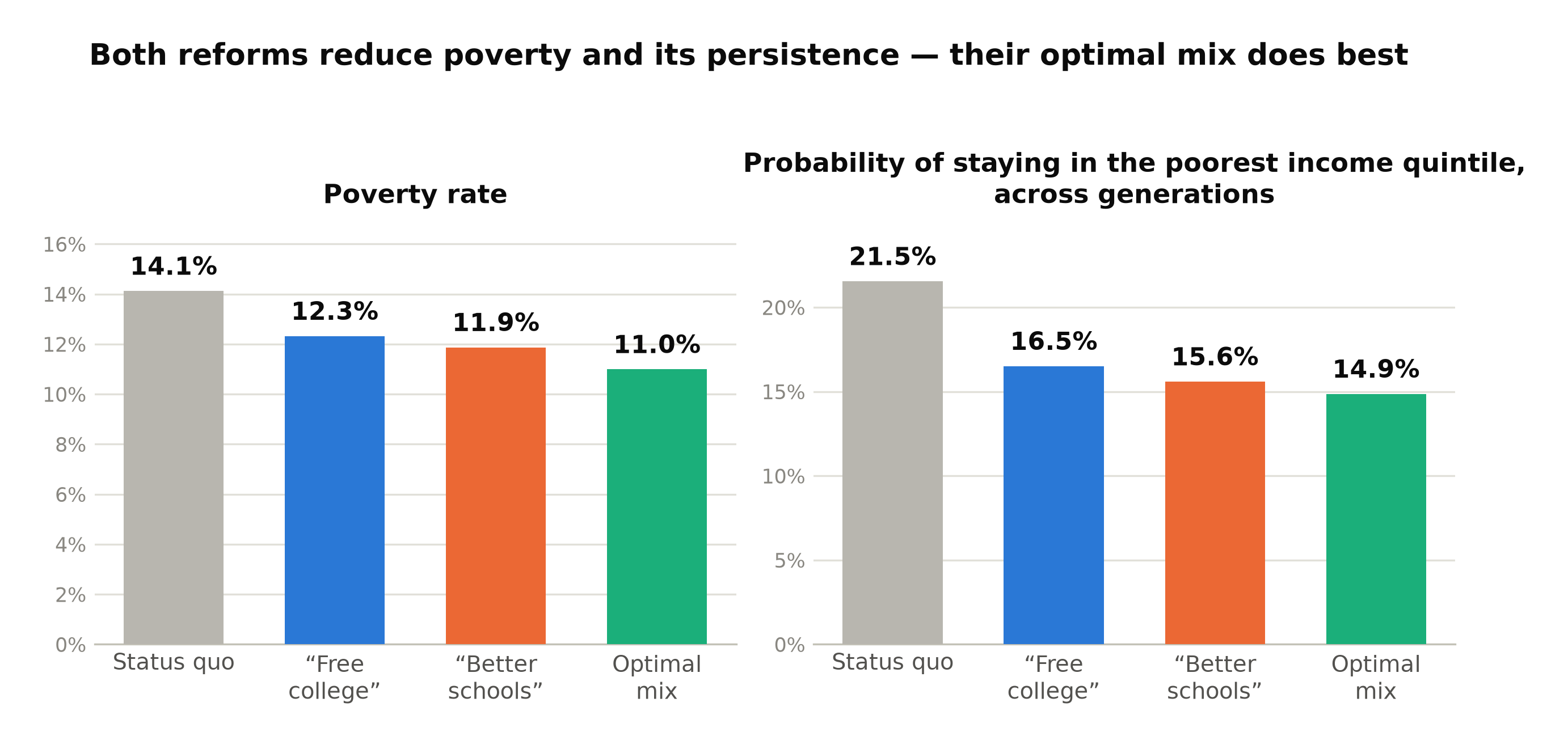
Both reforms raise college completion by roughly a quarter and more than pay for themselves in the long run, but they reach different children. “Free college” draws in under-prepared students—70% of extra entrants drop out—and for affluent families is a pure consumption transfer. “Better schools” acts earlier, cutting high-school dropout rates and building six times more pre-college human capital. Future generations’ welfare gains reach 11–15% of lifetime consumption, largest under “better schools”. The optimal spending mix raises welfare by 16% of lifetime consumption and cuts long-run poverty from 14.1% to 11.0% and its intergenerational persistence from 21.5% to 14.9%.
What implications does this have for the study (research and teaching) of wealth concentration or economic inequality?
Inequality at labour-market entry is endogenous and not policy invariant: shaped by education policy, family decisions and policy timing. Because early skills raise returns to later investment, fiscally equivalent policies can have different distributional and welfare effects. In equilibrium, expanding college compresses the college wage premium, and whether these policies pay for themselves in the long run depends on government debt availability. Our results emphasise the importance of pre-distribution policies relative to ex-post redistribution.
What are the next steps in your agenda?
We now study the supply side of college education—college quality, majors and tuition—and its response to the current and coming “demographic cliff”, technological change such as AI, and federal funding cuts, and what this implies for public finances.
Citation and related resources
Krueger, D., Ludwig, A. and Popova, I. (2025), ‘Shaping inequality and intergenerational persistence of poverty: Free college or better schools?’, Journal of Monetary Economics, 150, 103694
Replication code and data: https://github.com/irinaecon/free_college
NBER Working Paper 32467: https://www.nber.org/papers/w32467
CEPR Discussion Paper 19051: https://cepr.org/publications/dp19051


