The Child Penalty Atlas

What is this research about and why did you do it?
Despite significant progress in recent decades, the labour market gap between men and women remains substantial in almost all countries across different dimensions: employment, wages, promotions, and earnings (Olivetti and Petrongolo 2016). Recent research has shown that the differential impact of parenthood on men and women – so-called child penalties – accounts for much of the remaining gender gap (Kleven, Landais, and Søgaard 2019; Kleven et al. 2019). Prior evidence on child penalties has been limited to a small group of high-income countries. In Kleven, Landais, and Leite-Mariante (2024), we estimate child penalties for 134 countries around the world, representing more than 95% of the global population.
How did you answer this question?
Until recently, evidence on child penalties based on event studies of first childbirth has been limited to a small group of high-income countries due to strong data requirements (Kleven et al. 2019). The event study approach requires panel data on labour market outcomes over a long time horizon, which is not available for most low- and middle-income countries. We overcome this limitation by employing the pseudo-event study approach developed by Kleven (2026). This approach allows for the estimation of child penalties using widely available cross-sectional data. To conduct pseudo-event studies, we match recent parents with non-parents who are similar on observable characteristics. The matched non-parents are then imputed with future children, creating a pseudo-panel that includes both true parents and synthetic future parents.
What did you find?
Our main finding is that, while child penalties are a near-universal phenomenon, their magnitudes vary tremendously across places. In almost every country, parenthood has a clear and persistent negative impact on women’s employment, while men’s employment is virtually unaffected. But the size of the penalty varies enormously. To see this better, Figure 1 presents pseudo-event studies of the effect of first childbirth on employment for a selected set of countries.
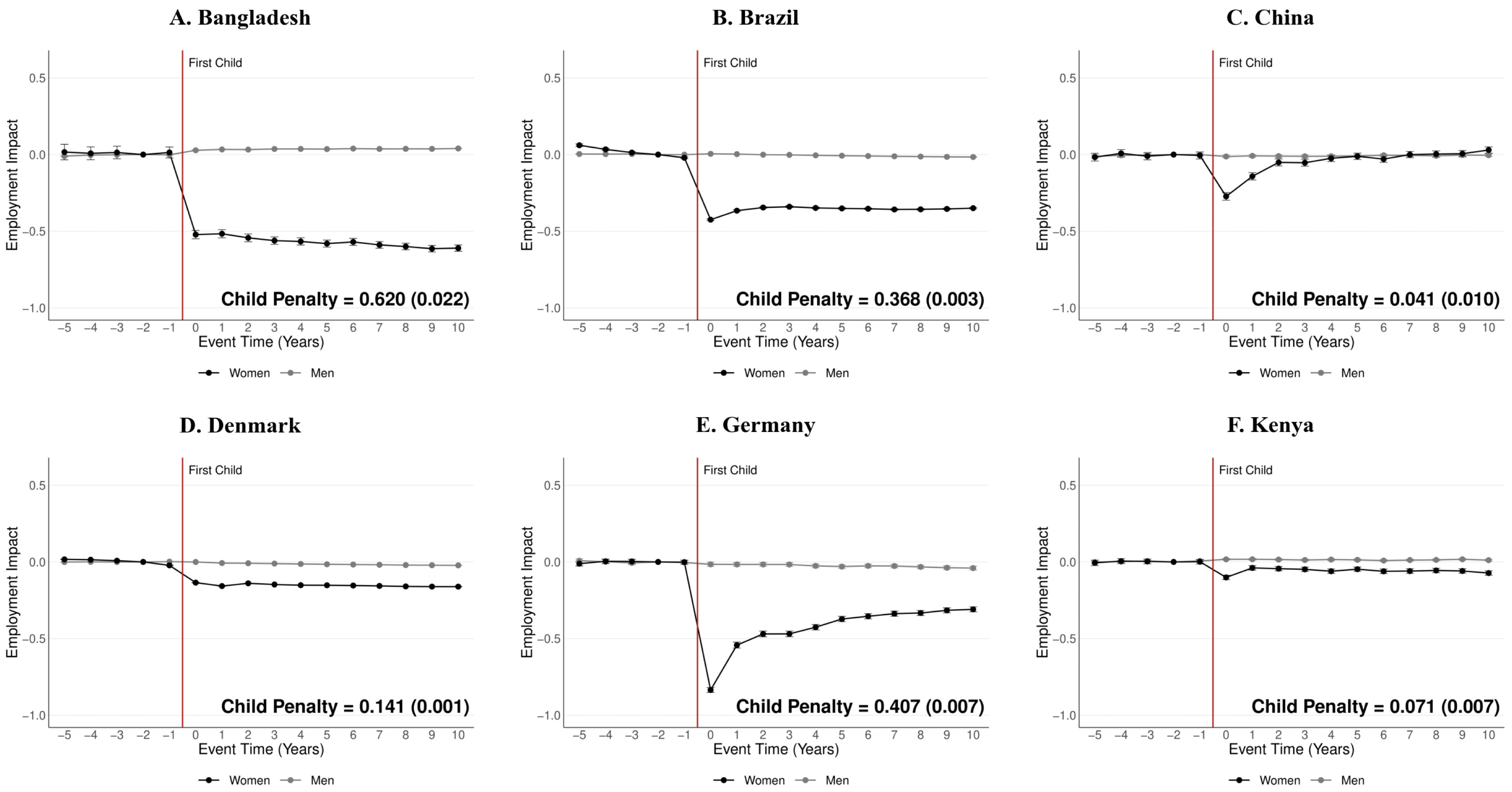
This figure presents event studies of first childbirth for a selection of countries. Each panel shows an event study of the impact of first child, depicted by the vertical line, on the employment rate of men (grey series) and women (black series). The series depict the percentage impact of childbirth at each event time. Each panel also displays the average child penalty over event times 0-10. The error bars depict 95% confidence intervals based on robust standard errors.
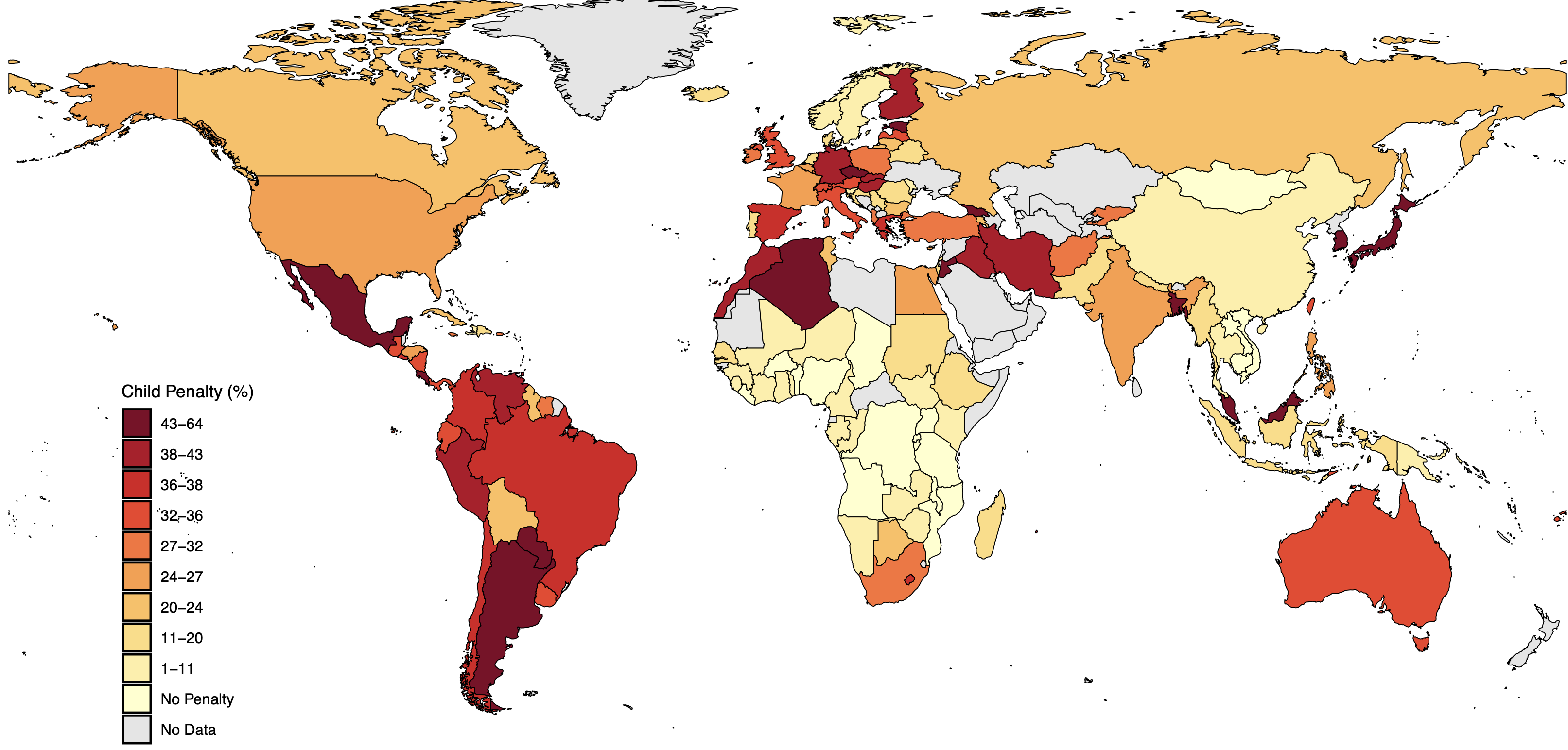
In Denmark, the child penalty in employment is about 14%. This means that female employment, over the ten years following first childbirth, drops by 14% relative to male employment as a result of parenthood. By comparison this number is 41% in Germany, 37% in Brazil, 4% in China, 62% in Bangladesh, and 7% in Kenya. In general, we find that child penalties are largest in Central Europe, Latin America and the Middle East, and that they are smallest in Scandinavia, Sub-Saharan Africa and Southeast Asia. Figure 2 presents a heatmap of child penalties around the world.
This figure presents event studies of first childbirth for a selection of countries. Each panel shows an event study of the impact of first child, depicted by the vertical line, on the employment rate of men (grey series) and women (black series). The series depict the percentage impact of childbirth at each event time. Each panel also displays the average child penalty over event times 0-10. The error bars depict 95% confidence intervals based on robust standard errors.
Figure 1: Event Studies of First Childbirth in Selected Countries This figure presents event studies of first childbirth for a selection of countries. Each panel shows an event study of the impact of first child, depicted by the vertical line, on the employment rate of men (grey series) and women (black series). The series depict the percentage impact of childbirth at each event time. Each panel also displays the average child penalty over event times 0-10. The error bars depict 95% confidence intervals based on robust standard errors.
What implications does this have for the study (research and teaching) of wealth concentration or economic inequality?
The Child Penalty Atlas expands our understanding of global gender inequality in the labour market. By documenting child penalties across settings with fundamentally different political, economic, and cultural institutions, the atlas allows for richer analyses of mechanisms than within-country analyses of a single institutional setting. This is necessary for understanding how factors like government policy, labour market structure, and social norms together shape the evolution of child penalties and gender convergence. This is an important agenda for future research.
Citation and related resources
Kleven, H. (2026), “The Geography of Child Penalties and Gender Norms: A Pseudo-Event Study Approach.” NBER Working Paper No. 30176.
Kleven, H., Landais, C., and Leite-Mariante, G. (2024) “The Child Penalty Atlas.” The Review of Economic Studies, 92(5), 3174–3207.
Kleven, H., Landais, C., and Søgaard, J. (2019) “Children and Gender Inequality: Evidence from Denmark.” American Economic Journal: Applied Economics, 11(4), 181–209.
Kleven, H., Landais, C., Posch, J., Steinhauer, A., and Zweimüller, J. (2019) “Child Penalties Across Countries: Evidence and Explanations.” AEA Paper and Proceedings, 109, 122–126.
Olivetti, C., and Petrongolo, B. (2016) “The Evolution of Gender Gaps in Industrialized Countries.” Annual Review of Economics, 8(1), 405–434.
Related resources:
The authors provide an interactive website of their findings at https://childpenaltyatlas.org.