


What do central banks need from economics graduates in the age of AI?

Stefania Paredes Fuentes on the National Bank of Slovakia’s new Graduate Education Programme
Wendy Carlin, co-director of the Stone Centre at UCL and director of CORE Econ, recently gave the academic keynote at the launch of the National Bank of Slovakia’s Graduate Education Programme in Bratislava. The event explored the role central banks can play in economic education, and Wendy’s talk looked at what AI means for economics graduates and how CORE is responding with new AI tools for students. We spoke to the Head of Economic Education, Stefania Paredes Fuentes, about the programme, the skills central banks need from graduates, and why academics and central bankers need to talk to each other more.
Hi Stefania, thanks for talking to us. Could you start by telling us about your role at the National Bank of Slovakia (NBS) and the programme you’ve launched?
I joined the National Bank of Slovakia just over a year ago as Head of Economic Education. Before that I was an academic in the UK; my last role was at the University of Southampton. I’ve known Wendy for a long time, and I’ve been involved with CORE on various occasions. I was well embedded in economics education in the UK before I moved to Slovakia to join the central bank. In the last year, we designed and launched a Graduate Education Programme — a traineeship programme with a strong education component. We’re not just saying, “come and work with us, we’ll put you in a department and you’ll learn the bits you need.” There’s a gap between what students learn at university and what they need to be able to work in a central bank, so we decided the best approach was to provide proper academic training — combining macroeconomic modelling, econometrics, and so on, with how these things are actually applied in the day-to-day work of central banking.
What did you want the launch event to achieve?
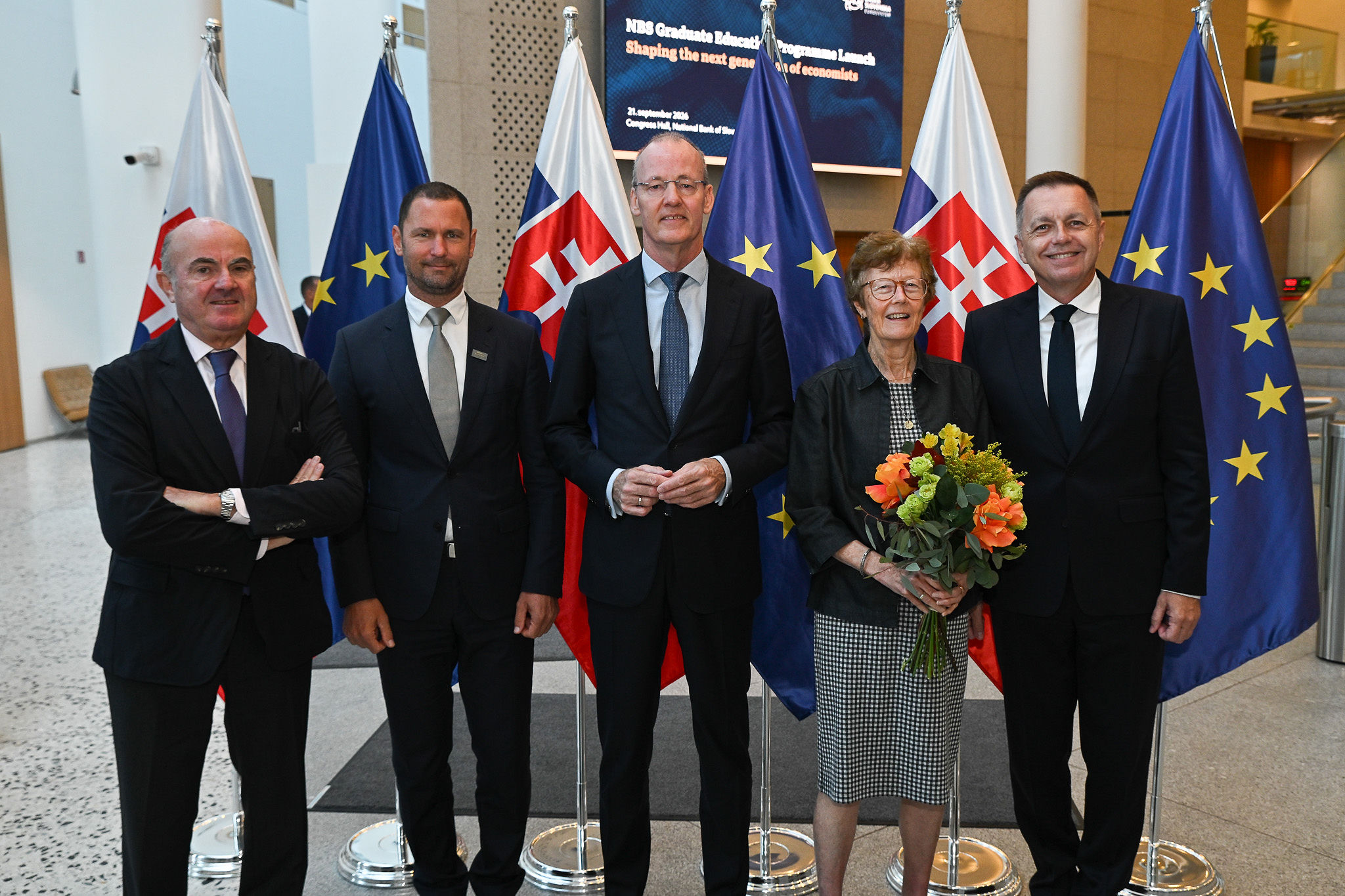
I wanted it to bring together the two key aspects of the programme: economics education and central banking. We had a policy panel on the role of central banks in economic education, chaired by NBS Governor Peter Kažimír. The panellists were Primož Dolenc, Governor of the Bank of Slovenia; Luis de Guindos, former Vice-President of the ECB; Klaas Knot, former President of De Nederlandsche Bank; and Josef Meichenitsch, Director at Austria’s central bank, the Oesterreichische Nationalbank (OeNB). They discussed things we’ve been talking about at NBS for a while: where the gaps are, what skills central banks will need in the future, and how the interactions between central banks and universities can be improved.
What was it like moving from academia to the central bank side of that conversation?
Fun! I spent my first year talking to colleagues at the central bank: “Tell me the skills you need in your team.” It was interesting, because I realised we were almost speaking different languages. I spoke a very “academic” language regarding modules, topics, and assessments; they were thinking more about day-to-day skills and applications. I think that’s one of the key things we fail to address in academia. When I was an academic, I’d ask employers, “What do you think our students are missing?” and we’d always end up having circular conversations about communication. Yes, we can train students in those things — but what else, from an academic perspective? This time I was sitting on the other side, asking my colleagues: how do we attract people here? How do we make sure we get good graduates into central banking? Students know what investment or commercial banks are, what the roles are, and how to get there, and they want to go there. It’s not the same with central banking. You don’t know what roles there are inside a central bank. What you see is the governor, and perhaps a few members of the monetary policy committee. There’s a huge gap between what students see and what actually happens inside the central bank, and filling that gap means bringing central bankers and economics educators together.
Where did Wendy Carlin fit into that?
Wendy represents the efforts academia is making to improve the way we teach economics. She shows that things are happening — the economics curriculum did not stop evolving 30 years ago, as some still try to argue. Things are moving, but they’re so dynamic that perhaps sometimes we fail to catch up — on both sides. Wendy’s lecture was very insightful and well received. Some people didn’t even know that economics education was a field — that people are thinking seriously about how to teach economics in a way that’s useful, inclusive, and forward-looking, rather than just delivering lectures.
Wendy’s talk also looked at the threat AI poses to the tasks entry-level economics graduates are trained to do. How did that land with your colleagues and the new cohort?
That was eye-opening. My colleagues seem to agree the gap between juniors and seniors is increasing. In the current job market, there are fewer jobs available at entry level. Some typical entry-level roles, or at least internships, involved running basic data analysis. However, this can be done more quickly using AI, creating fewer training opportunities. But on the other hand, we do want to train junior people. Senior colleagues are going to retire, and somehow we have to fill the gaps. How we fill them is going to change, particularly if we don’t have a strong talent pipeline.
The participants were there as well. On one hand, they’re super excited because they got into the programme and they’re now working in a central bank and learning new skills. On the other hand, they may be a little worried about what the future holds for them. But I hope they took the positives from it: they need to put more effort into their own training, and they shouldn’t let AI take their agency and do all the work for them. Wendy mentioned that people might fail to develop the skills they need to move forward, and the programme’s participants are showing that they want to develop those skills and actually learn. I had the luxury of selecting them almost one by one from an incredible pool of applicants, and we only had 14 or 15 places — we now have 14 people with us — so of course they’re really good. That’s not always the case in academia. We’re lucky to have a group of people who want to learn, and so far it has been very positive.
Wendy’s talk drew on a 2019 survey of UK employers, which found economics graduates highly proficient in quantitative skills but with room for improvement in applying what they’ve learned in a wider context. Is there anything about the way CORE teaches economics that made it particularly relevant to the event?
In conversations with employers, the key question is always, “What skills are students missing?” Very rarely do they say econometrics or data analysis. Good students are very good at data analysis, and at the basics of economics. But they’re good to the extent that if I ask them to list the transmission mechanisms of monetary policy, they can list those. When you put that in a broader context and they need to apply it — e.g. “This transmission mechanism didn’t work. What is it about the Slovak economy, compared with the Austrian economy, that might have affected it?” — they struggle to make connections and bring knowledge from different areas together to make sense of what we actually see. I think that’s what is really failing in more traditional economics teaching, whereas CORE is moving in the right direction: allowing students to develop critical thinking and see the broader picture, and recognising that while we learn the basics, sometimes we need to be more creative in how we apply what we learn.
It’s the difference between educating researchers — which is great; we need research — and educating economists for all other roles. For example, policymakers have to make decisions in much shorter time frames, with very incomplete information. Sometimes you can only weigh up the positives and negatives and say, “We’ll go with this one, because that’s the most we can do now.” That is not really taught in typical academic settings. CORE is trying to move that forward, but there’s still plenty of work to do.
Given the concerns about AI, how important are economics graduates to central banks?
That’s a very good question, and I’m not sure at this stage. For this programme, I was very open: I said I didn’t need people with an economics degree. I’d accept anyone with a quantitative background who was keen to learn economics in a very short time. I can train you in economics; I just need keen learners who believe they can learn things quickly. I expected a bit of a quantitative background as a signal that they’re interested enough in this kind of work, and that they’ll see quantitative analysis or econometrics as a challenge they can take on. As it happens, most of our participants this year have at least one degree in economics. Most have an undergraduate or master’s in economics, data analysis, management, or something related. So, they all have some basics of economics.
Of the people who applied, I’d say 80 to 90% had some form of economics degree. That’s not surprising, though: I imagine those who studied economics are more likely to know what a central bank is and what its main role in the economy is, and we noticed a real gap in understanding among those who hadn’t. Some applicants didn’t even realise that a central bank was completely different from a commercial or investment bank. I found that fascinating because, having been an economist my whole life, I assumed everyone understood what a central bank was. Educating people more broadly about what a central bank is and its role in the economy is a role for central banks in any case. I think we have to start at a much younger age than master’s degrees. An economics degree is important — some things are easier to explain to economics students because you can skip the basics — but I don’t think it’s 100% necessary.
If economics degrees are going to keep equipping graduates for jobs in places like central banks, what needs to change over the next five or ten years?
It’s not just economics — a lot of degrees will have to upgrade themselves. But in economics, there’s currently a focus on basic econometrics and similar skills. That is important, and I understand people need to come with quantitative training, but this area is moving very quickly. We need people who understand the basics but can actually do something with the data. We’re noticing that we have a lot of very good technical people who can’t interpret the data or do any real analysis beyond running it and telling me the results. I could do that on my own with AI. So, what else? What is this telling me? Can you explain it beyond the technical aspects — to the general public, to a group of bankers, to business people? Being able to explain the same thing to different audiences, and target it well, is something that has to be developed more. Again, maybe not just in economics, but critical thinking needs more development too: the capacity to read something and almost immediately analyse it. There’s even a lack of understanding of what critical thinking is. It’s not criticising everything you read for the sake of it. It’s thinking about it, finding the evidence, and forming an opinion. It takes time to develop that — some only develop it a few years into the job — but these skills are becoming more and more valuable, and developing them can’t be delayed any more.
I worked a lot on assessment when I was in academia, and I think one of the key things that has to change is how we assess students. There’s still a lot of memorising and writing exams, and with AI there’s now a huge call to go back to sit-down, three-hour exams in a classroom. I don’t have anything against exams per se, but asking people to memorise concepts and write them on a piece of paper just gives you peace of mind that they’ve read what you said they should read — and I don’t think it helps them develop any of the skills they actually need. We know assessment is the key motivator for students at university. If you do well, you get a 2:1 or a first and then a good job — that has been the pipeline so far. So of course students pay a lot of attention to assessment, but not enough attention is being given to designing assessments that help develop the skills that are needed. Universities need to invest a lot more in changing that, as well as in their teaching.
Are these issues new?
No, critical thinking and the ability to communicate with different audiences were already lacking. AI has just made these gaps more urgent. We’d been talking about assessment for many years too. During COVID, I was almost positive that there was a movement towards improving assessment: we couldn’t hold exams any more, so people were really willing to embrace different forms of assessment. Not always in the best way, but at least there was an openness to think outside the box. Then after COVID — and I don’t think we’ve fully recovered — people went back to the previous assessments, without taking into account anything that has happened since, including AI. We’re setting up degrees that are not fit for purpose any more. Maybe they weren’t ten years ago either, but the job market was good enough that employers could still recognise the good students coming out of universities and give them jobs. We’re not in that situation now. We have people coming out of universities whose capabilities employers can’t actually recognise, and there aren’t as many jobs available as there used to be. Suddenly there are 500 applications for one position, if not more.
So far I’ve been lucky: I haven’t had 800 applications for one position, and I still look through the applications myself — I sit down and spend two days sifting through them. But it’s becoming more difficult, and some people might be using AI to do it already. So suddenly we have AI writing job applications that are going to be read by AI! Universities aren’t doing enough to catch up — to ensure that their students acquire the skills they need in the job market, or are able to demonstrate them — even though we’re living in a different world. On the employer side, I’m quite happy with our programme because it delivers some of what’s needed, but not every employer can afford to set up a programme that teaches you whatever you didn’t learn at university, or select 14 very good people from a pool of 300. In that sense, we’re lucky that the programme is helping us overcome some of these issues.
With universities falling behind and, in the UK at least, degrees costing far more than they used to, where does that leave students?
If you already have a job, you can at least try to keep up somehow — and if you don’t really keep up, you still have your job. But if you have to get the job first, it’s very difficult to know what you need to learn, because you’re not an insider yet. In the UK in particular, the graduate premium in the job market has decreased significantly over the last 20 years. But if you don’t have a degree, you won’t get a job in a central bank. That’s the tricky part.
Stefania, thank you so much for your time. It was fascinating to hear the central bank side of the story, and we wish you and your first cohort all the best for the year ahead.
You can find the full programme for the launch of the NBS Graduate Education Programme on the National Bank of Slovakia’s website. For more on AI and its effect on graduates, see our recap of the Stone Centre Workshop on AI, Analytical Disciplines, and Graduate Careers.
Authors

Stone Centre at UCL
Stone Centre at UCL.