Heidi Williams
Josh Schwartzstein
Harsh Gupta
Maya Durvasula
Marcella Alsan
Horng Chern Wong
Brian Amorim Cabaco
Weikai Chen
Clara von Bismarck-Osten
Matthew Nibloe
Julian Limberg
David Hope
Martin Nybom
Jan Stuhler
Mattia Fochesato
Sam Bowles
Linda Wu
Tzu-Ting Yang
Thomas Piketty
Malka Guillot
Jonathan Goupille-Lebret
Bertrand Garbinti
Antoine Bozio
Hakki Yazici
Slavík Ctirad
Kina Özlem
Tilman Graff
Tilman Graff
Yuri Ostrovsky
Martin Munk
Anton Heil
Maitreesh Ghatak
Robin Burgess
Oriana Bandiera
Claire Balboni
Jonna Olsson
Richard Foltyn
Minjie Deng
Iiyana Kuziemko
Elisa Jácome
Juan Pablo Rud
Bridget Hofmann
Sumaiya Rahman
Martin Nybom
Stephen Machin
Hans van Kippersluis
Anne C. Gielen
Espen Bratberg
Jo Blanden
Adrian Adermon
Maximilian Hell
Robert Manduca
Robert Manduca
Marta Morazzoni
Aadesh Gupta
David Wengrow
Damian Phelan
Amanda Dahlstrand
Andrea Guariso
Erika Deserranno
Lukas Hensel
Stefano Caria
Vrinda Mittal
Ararat Gocmen
Clara Martínez-Toledano
Yves Steinebach
Breno Sampaio
Joana Naritomi
Diogo Britto
François Gerard
Filippo Pallotti
Heather Sarsons
Kristóf Madarász
Anna Becker
Lucas Conwell
Michela Carlana
Katja Seim
Joao Granja
Jason Sockin
Todd Schoellman
Paolo Martellini
UCL Policy Lab
Natalia Ramondo
Javier Cravino
Vanessa Alviarez
Hugo Reis
Pedro Carneiro
Raul Santaeulalia-Llopis
Diego Restuccia
Chaoran Chen
Brad J. Hershbein
Claudia Macaluso
Chen Yeh
Xuan Tam
Xin Tang
Marina M. Tavares
Adrian Peralta-Alva
Carlos Carillo-Tudela
Felix Koenig
Joze Sambt
Orazio Attanasio
Seth Zimmerman
Joseph Price
Valerie Michelman
Camille Semelet
Anne Brockmeyer
Pierre Bachas
Santiago Pérez
Elisa Jácome
Leah Boustan
Ran Abramitzky
Jesse Rothstein
Jeffrey T. Denning
Sandra Black
Wei Cui
Mathieu Leduc
Philippe Jehiel
Shivam Gujral
Suraj Sridhar
Attila Lindner
Arindrajit Dube
Pascual Restrepo
Łukasz Rachel
Benjamin Moll
Kirill Borusyak
Michael McMahon
Frederic Malherbe
Gabor Pinter
Angus Foulis
Saleem Bahaj
Stone Centre at UCL
Phil Thornton
James Baggaley
Xavier Jaravel
Richard Blundell
Parama Chaudhury
Dani Rodrik
Alan Olivi
Vincent Sterk
Davide Melcangi
Enrico Miglino
Fabian Kosse
Daniel Wilhelm
Azeem M. Shaikh
Joseph Romano
Magne Mogstad
Suresh Naidu
Ilyana Kuziemko
Daniel Herbst
Henry Farber
Lisa Windsteiger
Ruben Durante
Mathias Dolls
Cevat Giray Aksoy
Angel Sánchez
Penélope Hernández
Antonio Cabrales
Wendy Carlin
Suphanit Piyapromdee
Garud Iyengar
Willemien Kets
Rajiv Sethi
Ralph Luetticke
Benjamin Born
Amy Bogaard
Mattia Fochesato
Samuel Bowles
Guanyi Wang
CORE Econ
David Cai
Toru Kitagawa
Michela Tincani
Christian Bayer
Arun Advani
Elliott Ash
Imran Rasul

Representation and Extrapolation: Evidence from Clinical Trials

What is this research about and why did you do it?

Economists have long recognized that innovation--while key to growth--does not benefit everyone equally. New technologies skew toward the wealthy (who are more profitable), and diffusion is faster in better-connected networks. This paper identifies and investigates a third cause of inequality in innovation: unrepresentative product testing can systematically erode trust within excluded populations. We investigate this hypothesis---that who is in the data matters for diffusion---in the context of medical innovation, where Black Americans make up 13% of the population, yet are less than 5% of clinical trial participants (with the modal trial for a new medicine enrolling zero; see NASEM report for further details)

How did you answer this question?

We develop a model of how people interpret data and pair it with a survey experiment of U.S. physicians and patients. In the theory, all individuals extrapolate more from data when they see themselves represented in it: evidence is viewed as more relevant and people update more readily, with diminishing returns to representation. We test these predictions by cross-randomizing medication efficacy with the demographic composition of patients in a (hypothetical) clinical trial for a new medication. We then measure how these features affect physicians’ beliefs about effectiveness for their patients and their willingness to prescribe the medication. We similarly randomize the efficacy and representation to Black and White patients, and query them on willingness to adhere to the medicine. Comparing responses across treatments provides a measure of how representation shapes updating on medical evidence and take-up of new technologies.

What did you find?
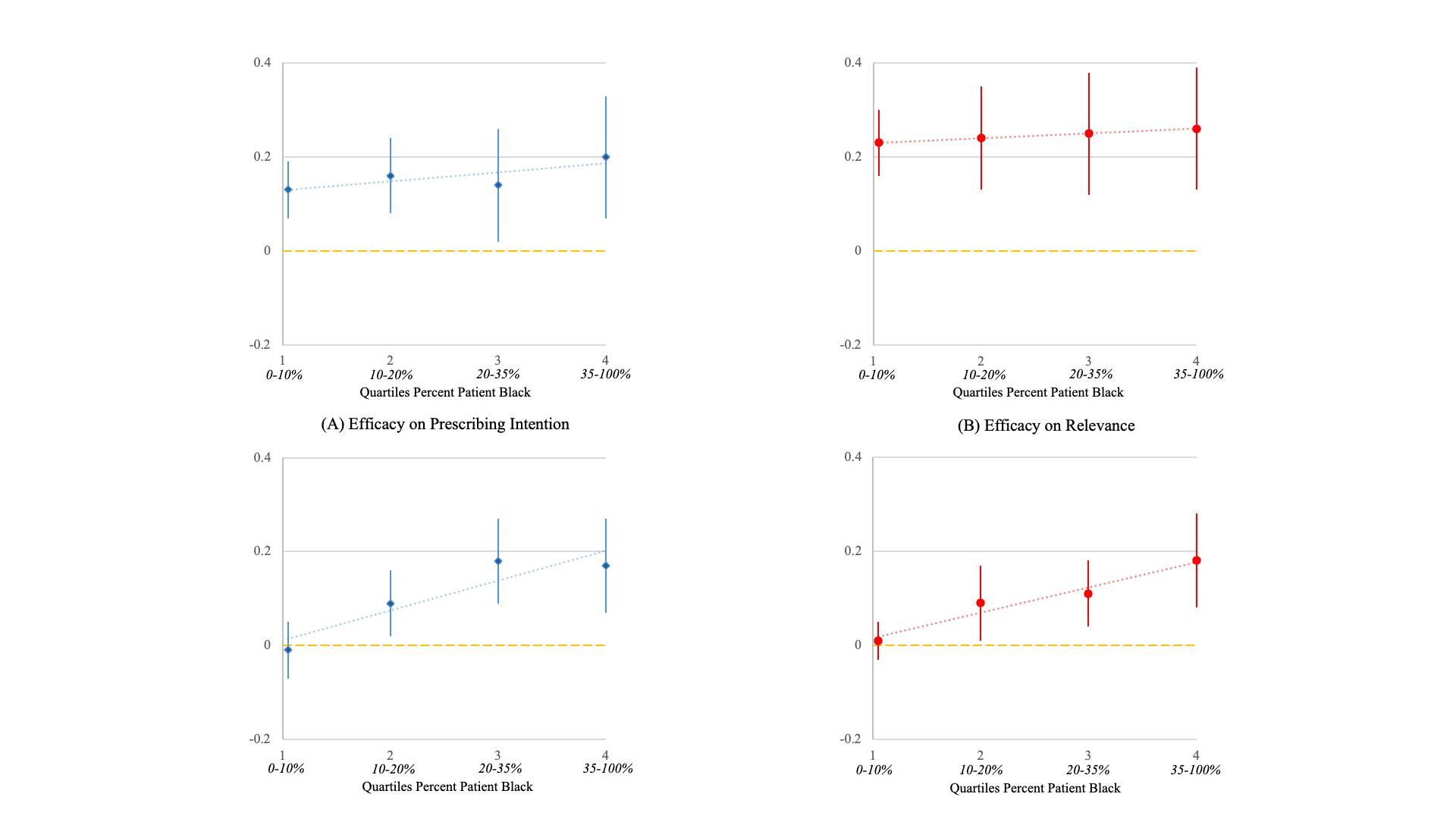
Heterogeneity among Physicians by Racial Composition of Patient Panel The figure plots OLS estimates for two outcomes—Relevance (Panels A and C) and Prescribing Intention (Panels B and D)—from specifications estimated with interaction terms between each quartile of patient percent Black and either Representation or Efficacy. The figure plots the linear combination of the main effect and the interaction with each quartile; quartile one is defined as the reference. Robust standard errors are clustered at the physician level. Ninety-five percent confidence intervals are displayed. Unless provided in the caption above, the following copyright applies to the content of this slide: © The Author(s) 2023. Published by Oxford University Press on behalf of the President and Fellows of Harvard College. This is an Open Access article distributed under the terms of the Creative Commons Attribution License (https://creativecommons.org/licenses/by/4.0/), which permits unrestricted reuse, distribution, and reproduction in any medium, provided the original work is properly cited.
Figure II Heterogeneity among Physicians by Racial Composition of Patient PanelThe figure plots OLS estimates for two outcomes—Relevance (Panels A and C) and Prescribing Intention (Panels B and D)—from specifications estimated with interaction terms between each quartile of patient percent Black and either Representation or Efficacy. The figure plots the linear combination of the main effect and the interaction with each quartile; quartile one is defined as the reference. Robust standard errors are clustered at the physician level. Ninety-five percent confidence intervals are displayed. Unless provided in the caption above, the following copyright applies to the content of this slide: © The Author(s) 2023. Published by Oxford University Press on behalf of the President and Fellows of Harvard College. This is an Open Access article distributed under the terms of the Creative Commons Attribution License (https://creativecommons.org/licenses/by/4.0/), which permits unrestricted reuse, distribution, and reproduction in any medium, provided the original work is properly cited.

What implications does this have for the study (research and teaching) of wealth concentration or economic inequality?

The findings highlight a new mechanism through which inequality persists: when key inputs into decision-making (like data or evidence) are unrepresentative, learning is systematically tilted towards unequal adoption of beneficial technologies. It complements other work members of our research team have done on the importance of diversity in medical professionals (Alsan et al., 2019). For research, it underscores the importance of incorporating endogenous belief formation into models of inequality. For teaching, it emphasizes that who is included in data generation shapes outcomes, linking informational environments to the persistence of economic and health disparities.

Citation and related resources

Alsan, Marcella, Owen Garrick, and GrantGraziani. 2019. "Does Diversity Matter for Health? ExperimentalEvidence from Oakland." American Economic Review 109(12): 4071–4111.DOI: 10.1257/aer.20181446

Alsan, Marcella, Maya Durvasula, Harsh Gupta, JoshuaSchwartzstein, and Heidi Williams. 2024. “Representation and Extrapolation:Evidence from Clinical Trials.” Quarterly Journal of Economics 139 (1):575–635. https://doi.org/10.1093/qje/qjad036


National Academies of Sciences, Engineering, and Medicine.2022. Improving Representation in Clinical Trials and Research: BuildingResearch Equity for Women and Underrepresented Groups. Washington, DC: TheNational Academies Press.


https://www.youtube.com/watch?v=WylQEpEVnK4

About the authors

Marcella Alsan

Stanford University.

Marcella Alsan
Maya Durvasula
Josh Schwartzstein

Harvard Business School.

Josh Schwartzstein
Heidi Williams

Dartmouth College.

Heidi Williams