


Understanding High-Wage Firms: Monopoly, Monopsony, and Bargaining Power

What is this research about and why did you do it?
Why do some firms pay more than others? Recent research has greatly improved our understanding of labor market power and product market power, but usually studies them separately and says less about collective bargaining. This paper brings these forces together in one framework to understand how firm market power and worker bargaining power shape wages and welfare, and whether high-wage firms pay more because they are more productive, because they earn larger rents, or because workers capture a larger share of those rents.
How did you answer this question?
I combine rich French data on workers, firms, and product prices to study how high-paying firms differ from other firms. I then build and quantify a model in which wages are shaped by both firm market power and worker bargaining power. This lets me connect observed differences across firms to underlying mechanisms and quantify how much each one matters for wages and welfare.
What did you find?
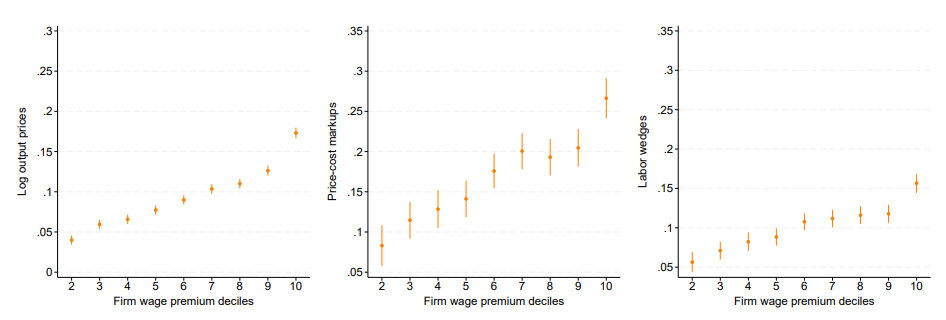
High-wage firms are not simply more productive monopsonists. Even conditional on productivity, they charge higher prices, have higher markups, and pay workers a larger share of their marginal revenue product as wages. The model shows that product quality and worker bargaining power are central to explaining these patterns. Quantitatively, product market power accounts for most of the welfare losses from firm market power. Raising worker bargaining power improves wages and welfare, but even full bargaining power closes only about one-third of the gap to a social planner benchmark.
What implications does this have for the study (research and teaching) of wealth concentration or economic inequality?
The paper suggests that understanding wage inequality requires looking beyond labor market power. Some wage differences across firms reflect workers sharing in product market rents, not just monopsony. It also shows that stronger worker bargaining power can improve wages and welfare, but is a limited substitute for addressing product market power. This matters for how economists study and teach the relationship between rents, bargaining, inequality, and worker welfare.
What are the next steps in your agenda?
My broader agenda is to study how firms shape inequality and welfare through market power, technology, and worker bargaining. Next, I want to understand how these forces interact across different types of workers, across firms, and over time, and what that implies for policy.
Citation and related resources
Wong, Horng Chern. “Understanding High-Wage Firms: Monopoly, Monopsony, and Bargaining Power.” American Economic Review, forthcoming.

Assistant Professor of Economics at Stockholm University. Research affiliate at the Rockwool Foundation Berlin.